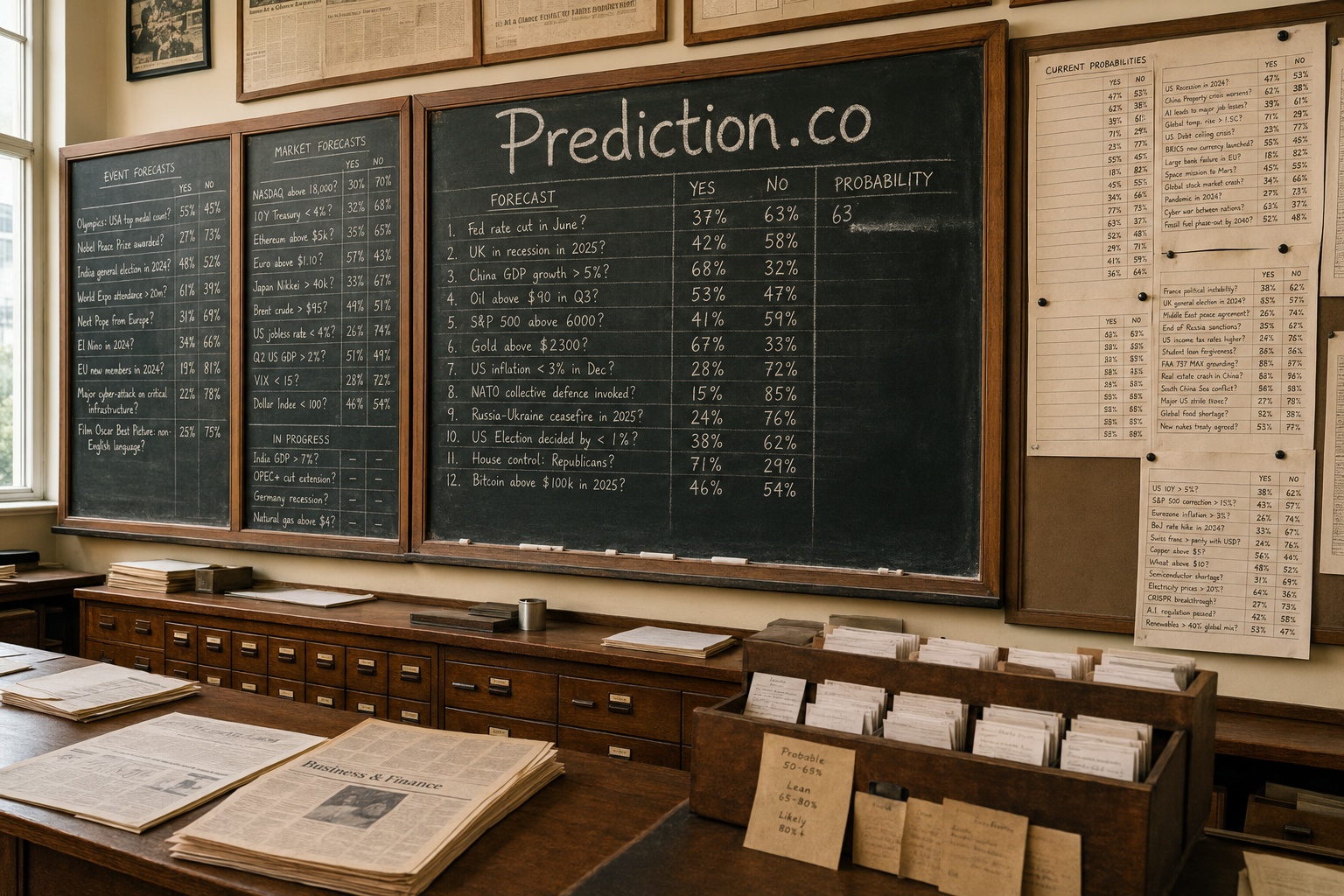
I imagine a public forecast room as the opposite of a disappearing feed. It is a place where important calls are written down before the outcome, updated when evidence changes, and reviewed after reality arrives. Prediction.co gives that idea a direct address. The product would serve people who want to understand judgment over time: editors, researchers, operators, students, and readers who are tired of bold claims that cannot be found a week later.
The central object is a forecast card. It asks one precise, resolvable question; records a probability; identifies a closing condition and date; names the forecaster or method; and shows the sources that informed the call. A card is not a loose opinion. The question has to be clear enough that two reasonable reviewers can agree on what happened. The Good Judgment Open forecasting platform demonstrates useful forecasting conventions, while the Metaculus FAQ offers another public example of question and resolution design.
Preserve the first call
Every change belongs in the history. If a forecaster moves from 40 to 65 percent, the room should retain both values, the timestamp, and a short reason. New evidence may justify the revision; that is healthy updating, not inconsistency. Quietly overwriting the old number would destroy the learning value. A compact timeline can make revision legible without turning the page into an engineering log.
The room needs a strict distinction between evidence and interpretation. A source note might say that an agency published a new monthly series. The interpretation explains why that release changes the probability. Readers should be able to open primary sources whenever possible. The Federal Reserve Economic Data service is a model of citable public data, and the Congressional Budget Office shows how assumptions and projections can be documented for scrutiny.
Question selection is editorial work. The room should avoid vague prompts, questions whose resolution depends on taste, and events too trivial to justify attention. A good mix would include near-term public questions, medium-term sector questions, and a smaller set of long-horizon forecasts that force explicit assumptions. Each category should have an owner who checks source health, closing dates, and ambiguous developments.
Make disagreement useful
A public room gets interesting when informed people disagree for stated reasons. Rather than attach a generic comment thread, Prediction.co could invite structured challenges. A challenger selects the assumption they dispute, offers a source, and proposes a revised probability. The original forecaster can accept the evidence, explain why it is already represented, or flag a genuine unknown. This creates a readable map of the disagreement.
The product can show a crowd estimate alongside named forecasts, but it should not imply that aggregation always settles the question. Participation may be self-selected, coordinated, or sparse. A clear count, distribution, and participation note keeps the number honest. When experts are invited, the criteria for their designation should be public. Labels should describe evidence of expertise, not confer status through branding alone.
Resolution needs the same care as publication. Before a question opens, the card should name the expected source and rule. When the outcome arrives, a resolver links the evidence and applies the rule. Edge cases go to a visible review process. If the question was flawed, the room can mark it invalid and explain why. Protecting the score at the expense of a truthful record would undermine the entire project.
Score patterns, not personalities
Individual scores can motivate good habits, but a leaderboard easily turns uncertainty into performance theater. I would emphasize calibration bands, question categories, and improvement over time. A forecaster who openly recognizes weak knowledge may be more useful than someone who takes dramatic positions on easy questions. The room should reward clear reasoning, appropriate confidence, and responsible revision.
Team reviews could examine recurring failure modes: anchoring on the first estimate, reacting too sharply to one headline, ignoring a base rate, or choosing sources that all repeat the same origin. These reviews become public editorial articles. They give readers tools for their own judgment and show that the room treats misses as material for improvement rather than embarrassment to bury.
Moderation is essential. Predictions about public events can attract manipulation, harassment, and low-quality certainty. The product needs rules against personal targeting, unsupported allegations, coordinated influence, and questions that create obvious harm. Some topics should remain outside the room. A written standards page and named editorial responsibility would be part of the launch, not an afterthought.
Build a room people can visit
The visual metaphor should feel physical: a daylight wall board, pinned source sheets, neat date stamps, and chalk revisions. That atmosphere signals work in progress. It is warmer and more editorial than a financial dashboard. A visitor sees what is open, what changed today, what resolves next, and what the room learned last week.
The public core can support a business without closing the archive. Organizations may pay for private rooms, controlled teams, custom question sets, exports, or facilitated review sessions. Publishers may embed individual forecast cards with attribution. Universities could use public collections in courses. The shared principle is that a paid feature adds coordination or workflow rather than making basic accountability inaccessible.
I would begin with twenty questions and a small invited cohort. Before launch, a separate editor would try to break every resolution rule. The team would publish its standards, run a full practice cycle, and release the archive with outcomes already represented. That proof matters more than a large opening roster.
My experience building category properties has taught me that the name and the operating habit must reinforce each other. Prediction.co promises a place about forecasts. The public room earns that promise through memory: it holds the original call, the reason for every turn, and the final evidence. Over time, that record can become more valuable than any single number on today’s board.
The result is not an oracle and should never perform as one. It is a disciplined public notebook for uncertain questions. Its achievement would be quieter: better questions, cleaner sources, visible updating, fair resolution, and a community that becomes a little less impressed by confidence unsupported by a record.